FAMILY :: RUBIACEAE
AVAILABILITY (summer 2025)
Rooted cutting (6-10 cm tall) – $300 (out)
1 year old (60-100 cm tall) – $500
2 year old (100 – 200 cm tall – $1000
KRATOM: A tender, large tropical tree from Southeast Asia whose leaves are used as a stimulant in small doses (1-5 grams) and a sedative or euphoric in larger doses (over 10 grams). It is related to coffee and chinchona (the botanical source of quinine).
Kratom requires tropical conditions of humidity, warmth, rich soil and partial shade for good growth. Grows very rapidly, up to 2-3 meters a year. It goes semi-dormant in the winter here in Vallarta, resuming active growth in May.
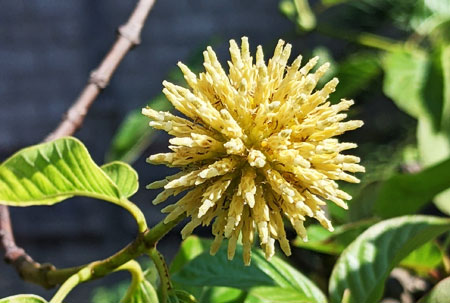
It contains the tryptamine alkaloids, mitragynine and 7-hydroxymitragynine (7-OH) which are similar chemically to yohimbine in structure but not in effect. Medicinally, kratom is used as a pain killer, for diarrhea and as a treatment for opiate addiction. This plant is illegal in Australia, Denmark, Finland, Israel, Lithuania, Malaysia, Myanmar, Poland, Romania, South Korea, Sweden, United kingdom and in some parts of the US. The plant, itself, is not scheduled by the US government although the FDA is recommending that 7-hydroxymitragynine (7-OH), a synthetic, concentrated substance derived from kratom leaves, be classified as a Schedule I substance under the Controlled Substances Act. Although trace amounts of 7-OH are found in the kratom leaf, kratom products would not be affected by the scheduling recommendation and scheduling would apply only to concentrated 7-OH. The predominant alkaloid in kratom is mitragynine, which makes up about 60%-65% of dried leaves.
The leaves of the Kratom plant contain a variety of alkaloids, including several psychoactive alkaloids and is traditionally prepared and consumed in Southeast Asia, where it has been known to exhibit both painkilling and stimulant qualities, behaving as a mu opioid receptor agonist, and often being used in traditional Thai medicine in a similar way to and often as a replacement for opioid painkillers like morphine.
A common route of administration is by chewing the fresh leaves at a dosage of normally 10 to 30 leaves per day.
“Kratom is believed to act on opioid receptors. At low doses, kratom acts as a stimulant, making users feel more energetic. At higher doses, it reduces pain and may bring on euphoria. At very high doses, it acts as a sedative, making users quiet and perhaps sleepy. Some people who practice Asian traditional medicine consider kratom to be a substitute for opium…
Kratom takes effect after five to 10 minutes, and its effects last two to five hours. The effects of kratom become stronger as the quantity taken increases. In animals, kratom appears to be more potent than morphine.” — Mayo Clinic
Many years ago, we went to Bangkok to obtain Kratom specimen plants for the nursery. We met with a man in our hotel bar and he called a “friend” of his who he said could get us the plants. Part way into the call he looked disappointed and said that we could not get the plants then because the Thai government had just made Kratom illegal and that the police were executing people who sold it because the US president was visiting and they needed to put on a show for him in order to get some kind of drug war funding.
I asked how his friend knew all of this and he replied that his “friend” on the phone was a police chief in Bangkok. His friend said that we should try again in a few weeks after the US President had left.
— A follow-up to my experience in Bangkok: Kratom Now Legal in Thailand
KRATOM “VARIETIES”
Kratom use has been popular in the US for almost a decade and, as with many fads, in order to increase sales and interest, vendors have offered” different “strains” of the plant. I’ve seen this marketing technique used with other active plants like marijuana, khat and salvia. While there may actually be “varieties,” most of these differentiations are marketing tools, not reality. If the differences are real, they are most likely the result of additions of other chemicals to the product.
I sell live kratom plants so there are absolutely no chemical “modifications.” Supposedly, there are 4 types of kratom, according to leaf vein color: red, white, green and yellow. From my well over 20 years of growing these plants, I can tell you that these vein colors are variable on individual plants according to growing conditions and season. The plants I grow have white veins in the summer and red veins in the winter. Soil deficiencies may also affect vein color in plants making this method of differentiating varieties of this plant a bit of a joke, especially since it is virtually impossible to know where the product is from or its growth, harvest and processing conditions.
Caveat emptor
MORE INFORMATION
- A LEAF OF FAITH (2018) KRATOM DOCUMENTARY
https://www.youtube.com/watch?v=tpDM2yUnnJ0 - Good, current article on Kratom:
https://www.sfgate.com/culture/editorspicks/article/kratom-legality-sf-15982630.php - The Science Behind Kratom’s Strange Leaves
- The UN Report on Kratom
World Health Organization – Kratom, mitragynine, 7-hydroxymitragynine pre-review report – unedited version, 8 September 2021